Your agent edited a drawing. This says whether the room count changed — or where it can't tell.
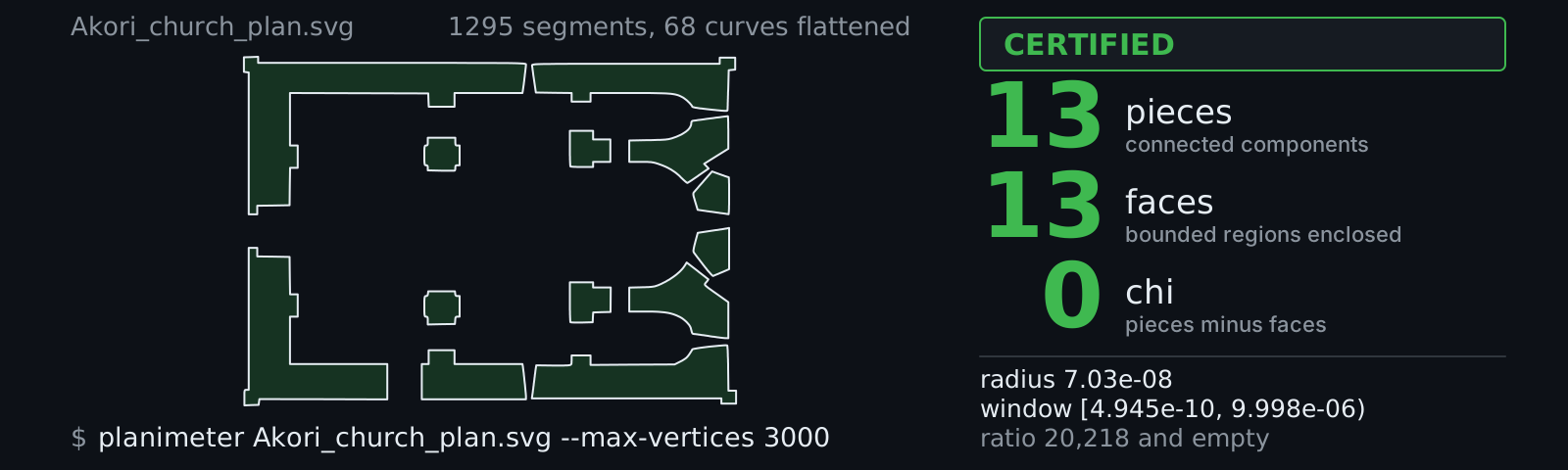
pip install planimeter
planimeter --demo # a built-in 2x2 grid: pieces 1, faces 4, chi -3, and the tolerance that decided them528 constructed drawings with endpoints microns apart: 495 exact, 33 refused, 0 wrong. Same
files, shapely.polygonize_full gets 336 wrong and refuses none. Constructed corpus —
the real-file numbers are worse, and they are below.


You told the agent to add a wall that splits the room in two, and it says it did. This reads the file it wrote and tells you the room count went from 4 to 5.
Or it tells you the new wall stops two millionths of a unit short of the floor, and hands you that corner. At that distance nobody can tell whether the wall touches — so it does not pick one of the two answers and hope. It says which corner to go and look at.
Installed as a hook, it stamps one short line after every drawing the agent writes. Nobody has to open the picture to find out what is in it.
- It reads the lines out of the file. No picture is ever drawn, so there is no resolution to choose and nothing to look at.
- Two line ends sitting at exactly the same spot are one corner. Nothing else is joined yet, and nothing is moved.
- It works out every distance that could possibly join two corners, and sorts them from smallest to largest (single-linkage merge heights, which are exactly the n-1 edges of a Euclidean minimum spanning tree).
- It hunts for a wide empty stretch in that sorted list — one where the top is at least ten times the bottom. Below the stretch is the drawing's wobble; above it is real space. Corners closer than the stretch are the same corner (the certified snap radius).
- Counting is then arithmetic. The corners, the lines and the number of separate pieces give the enclosed room count exactly, with no picture, no tolerance you invented and no floating-point guess (faces = E − V + C, Euler 1758).
- If there is no wide empty stretch, or a line end sits inside the doubtful range beside a wall it does not quite touch, it prints that coordinate and refuses instead of picking one of the two answers.
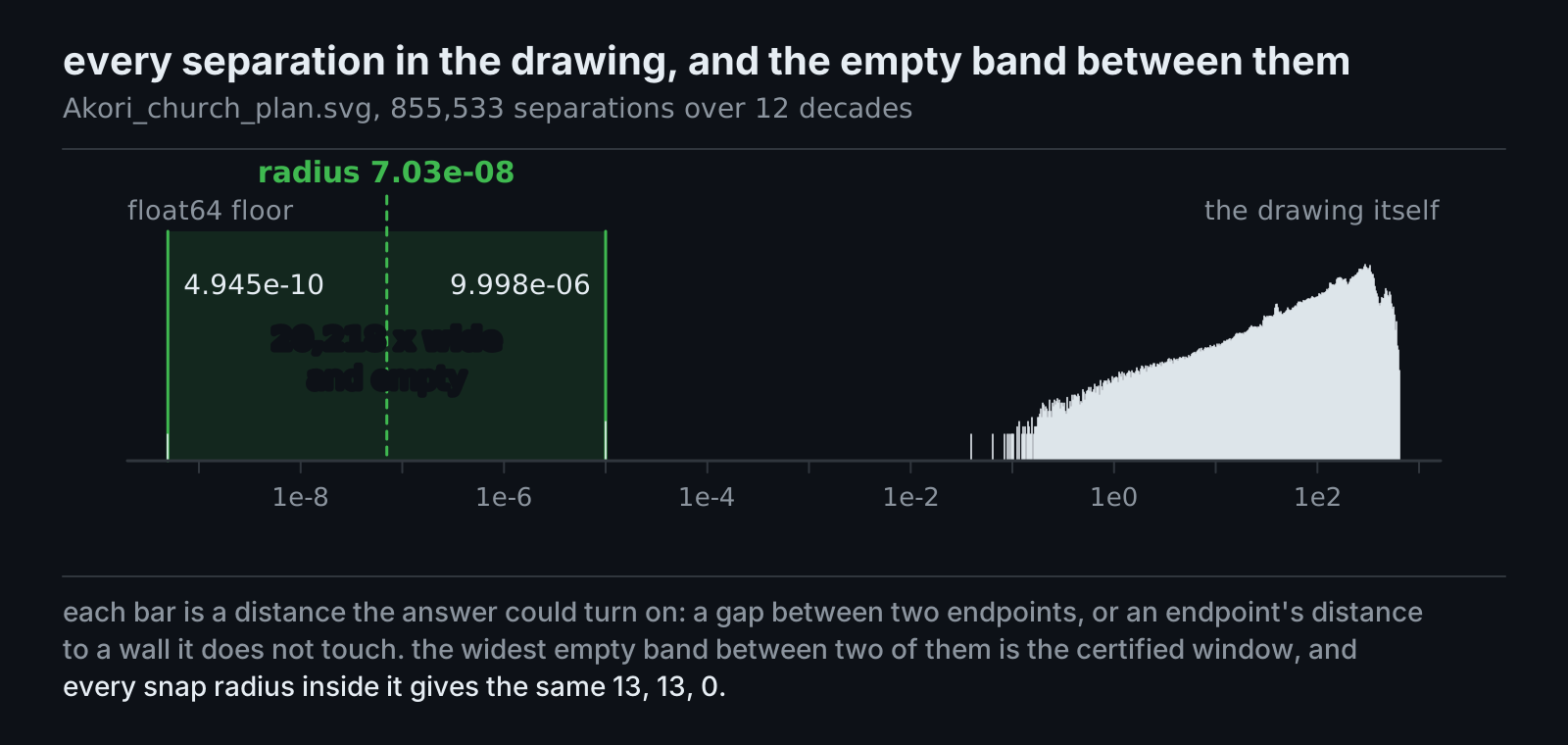
Step 4 is the whole product. Above is every separation the answer could turn on in one real floor plan — corner to corner, and corner to a wall it does not touch — with the empty band the tool found. Every tolerance inside that band gives the same 13 rooms, and the band is 20,218 times wider than it is low. That ratio is printed on every answer, so what the count rests on is visible.
Four things make it refuse, and the first two are the reason this exists.
- A line end near a wall but not on it. Close the gap and the wall divides the room; leave it and the wall is a dangle. Nothing in the file says which.
- Two lines that cross where the file records no corner. Same problem: the crossing is either a junction or an overlap, and the drawing does not say.
- No wide empty stretch anywhere. The distances run smoothly from tiny to large, so no tolerance is more defensible than the one next to it.
- The drawing is bigger than this machine will check. That is a fact about the machine, not the drawing, and it is labelled
budgetrather thangeometryso you can tell them apart.
A refusal is never a number. You get the reason, the coordinate in the file's own units, the id of
the element that owns it, and one thing to do — then exit code 2.
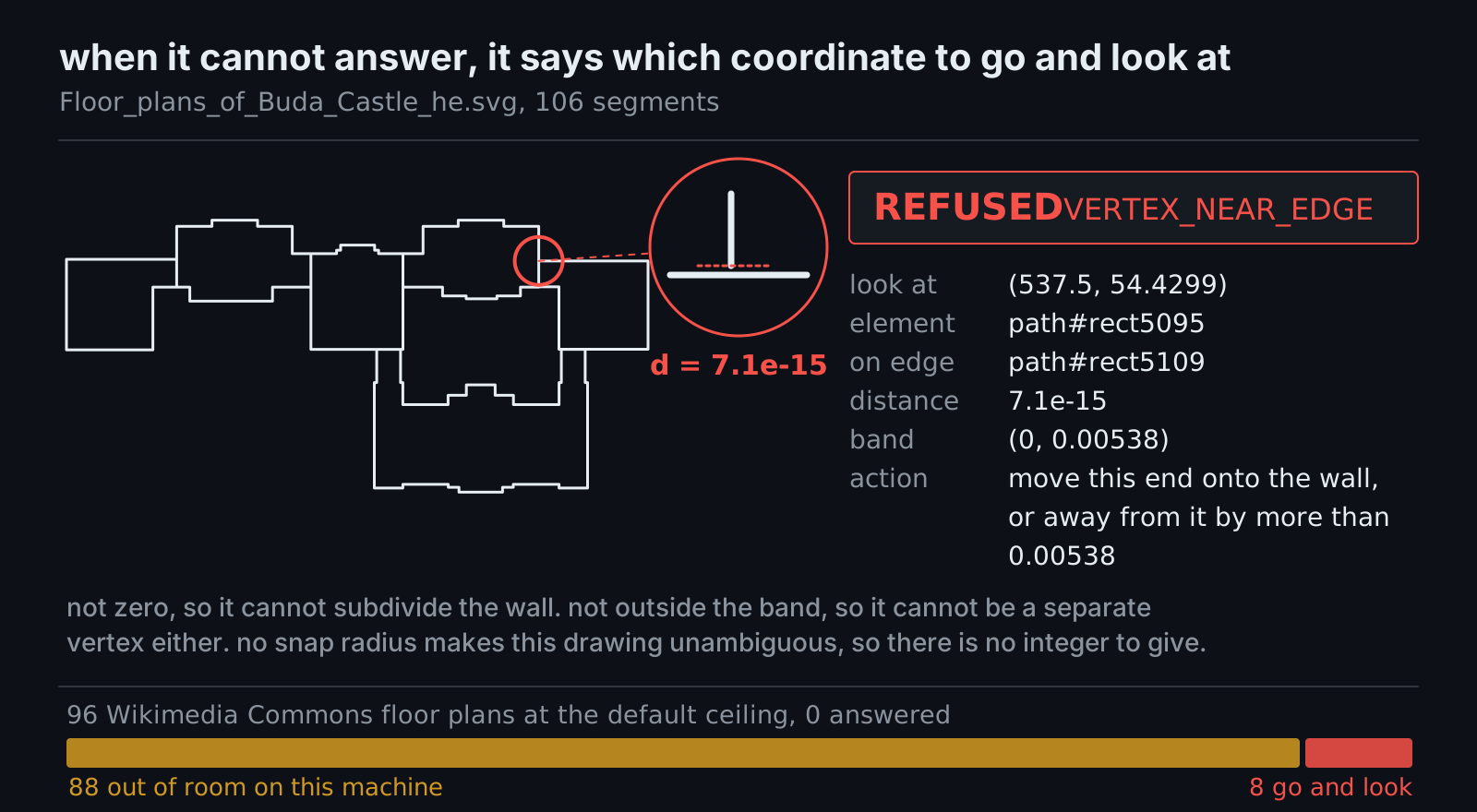
What you do about it. For a geometry refusal, open the file at that coordinate and decide:
move the end onto the wall, or move it away by more than the number printed. For a budget
refusal, pass --max-vertices or split the file.
How often, on real files. One icon in five refuses. Published floor plans refuse almost always: 0 of 96 at the default ceiling and 1 of 96 with the ceiling raised, because a published plan is drawn rather than built — walls end near walls, walls cross with no corner recorded. Those are exactly the two conditions above. That is the price of never being wrong, and it is stated here rather than three screens down.
For a graph drawn in the plane with V vertices, E edges and C connected pieces, where F
counts every face including the single unbounded one:
Write faces for the enclosed ones, F - 1. Then all three printed integers follow, and the
algebra is two lines:
A triangle: V = 3, E = 3, C = 1, so faces = 1 and chi = 0. That last term is the first Betti
number of the 1-complex — the count of independent cycles.
This is 18th-century arithmetic and it is not where the risk is. It is one union-find pass. The entire engineering problem is deciding which endpoints are the same endpoint, and that decision is what the window certifies.
Write π(r) for the partition of endpoints into groups at tolerance r — which ends are treated
as one corner. By Gower & Ross (1969) the single-linkage merge heights of a point set are
exactly the sorted edge weights of its Euclidean minimum spanning tree, so there are only n-1
tolerances at which π can change, and they can be listed once. The certificate is:
By Kruskal's cut property, for that partition the closest two groups are exactly t_above
apart. So the grouping cannot change until the tolerance reaches the top of the band, and the
band is rho times wide: the grouping survives a tenfold change in the tolerance. That is
strictly weaker than "the grouping is right", and saying which of the two is claimed is the
entire point of the tool.
==============================================================================
  planimeter  plan.svg
==============================================================================
  pieces               1
  faces                4
  chi                 -3      chi = pieces - faces = V - E
------------------------------------------------------------------------------
  vertices             9      edges           12
  subdivided           0      dup edges        0
  merged               0      max cluster diam 0
  snap window   [1.819e-12, 1)   ratio 5.498e+11   radius 1.349e-06   derived
  rho 10   flatten 16/32   candidates tried 1
  digest  c6fc6d6fbc54eb3c
==============================================================================
snap window [1.819e-12, 1) is the line no other tool prints. derived says planimeter chose
that band, not you. Zero-shot. No training. No neural network. No render. No resolution. No
GPU. numpy, svgelements, and a formula from 1758.
CERTIFIED means six things were checked, not assumed: a band at least rho wide exists;
every input segment survived the merge; every (vertex, non-incident edge) pair sits at distance
exactly 0 or at least t_above, nothing in between; no two segments still cross after
subdivision; the float64 margin condition holds, so every sign is provably correct without
rational arithmetic; and curves flattened at N and 2N gave identical integers.
| verdict | when | what you get | exit |
|---|---|---|---|
| CERTIFIED | all six hold | pieces, faces, chi, and the band that decided them |
0 |
| REFUSED | one named condition could not be established | the reason, the coordinate, the element id, one action | 2 |
| BAD INPUT | the file cannot be read, or the flags do not parse | not a verdict — the tool never ran | 3 |
==============================================================================
  planimeter  wall_missing_the_floor.svg                           REFUSED
==============================================================================
  reason   VERTEX_NEAR_EDGE   (geometry)
  detail   1 vertex sits inside the ambiguous band (0, 5)
  look at  (5, 2.2e-06)  element=line#s4  edge=line#s0  d=2.2e-06
  action   move this end onto the wall, or away from it by more than 5
==============================================================================
That is a crosswall missing its floor by 2.2e-6. Close the gap and the wall divides the room,
faces 2; leave it and the wall is a dangle, faces 1. Nothing in the file says which.
Every competitor returns one of the two integers. planimeter returns the coordinate.
Ten refusal codes, each actionable by a stranger, each in the file's own coordinates with the
owning element id: NO_STABLE_SCALE · VERTEX_NEAR_EDGE · EDGES_CROSS · EDGE_COLLAPSED ·
CURVE_UNSTABLE · MARGIN_TOO_SMALL · NO_GEOMETRY · TOO_MANY_PAIRS · TOO_MANY_VERTICES ·
BAD_INPUT. Every one carries a kind: geometry means go re-observe the drawing, budget
means this machine ran out of room.
Never claimed, in any code path or output string: watertight, manifold, valid, healed,
repaired — faces >= 1 is not closure and never becomes it. No area, length or perimeter of the
drawing: the instrument this is named for measures area by tracing a boundary, and this one only
counts boundaries. No confidence, probability or score.
And not what a renderer will draw. Two overlapping filled rectangles are 3 arrangement faces and 2 visible regions. That is the most likely "your number is wrong" moment, so it sits here and not in a footnote. Nor is the tolerance claimed correct, only certified.
planimeter init writes one PostToolUse entry. After that the agent gets an integer on every
geometric write and never has to look at the picture:
planimeter walls.svg  pieces 1  faces 4
planimeter walls.svg  pieces 1  faces 4 -> 5
planimeter walls.svg  vertex near edge
7 cl100k_base tokens of body, 5 more for the path. A write to notes.py produces zero
bytes — the suffix check runs before any import, costing under about 15 ms over an
interpreter that does nothing, and saving 84 to 105 ms on every non-geometry write
(RESULTS.md §6).
Four contract clauses, each with a test: silence is the default · bounded work or a budget refusal, never a stalled turn · it never raises (any exception → exit 0, empty stdout; a hook that can break a session gets uninstalled on day two) · it never writes to a geometry file, on any path — which is the whole reason a write-triggered hook is installable, and why "heal the geometry" will never be a feature here.
A refusal stamps its one non-imperative line only when the reason changed. Thirty identical refusal lines in a session train an agent to ignore the tool.
State the number before the edit; an integer checks the claim after it. No vision check and no area check can even express a claim of this shape.
planimeter check plan_loop.svg --faces 5 # after the edit landed CLAIM faces stated 5 measured 5 HELD
and the same claim against the file before it, which is the four-face plan.svg above:
planimeter check plan.svg --faces 5 CLAIM faces stated 5 measured 4 BROKEN
0 HELD · 1 BROKEN · 2 REFUSED. Three states, not two — "the tool could not answer"
must never be readable as "your prediction was wrong". Whether agents state the number
unprompted is unmeasured and NOT EARNED; init appends two lines to
CLAUDE.md asking for it, which is a nudge, not a result.
Every table, every control, and every arm that lost → RESULTS.md. No number in this repository is hand-typed; the blocks below are pasted from the tools' own stdout. Real input comes first because it is worse.
Two corpora fetched by a pinned recipe rather than picked one at a time, at commit 4a7a3dc.
Neither carries a ground truth, so every number here is a refusal rate or an agreement rate
between two methods, and never an accuracy
(RESULTS.md §11):
    13,681 npm icon files (tabler, feather, bootstrap, MIT, pinned versions)
        answered   10,862   79.4%       median 37 ms
        refused     2,819   20.6%       EDGES_CROSS 12.5%  VERTEX_NEAR_EDGE 5.5%
                                        CURVE_UNSTABLE 2.3%  budget 0.2%

    96 Wikimedia Commons floor plans — the advertised use case
        answered        0    0.0%       at the default vertex ceiling
        answered        1    1.0%       at --max-vertices 6000
        refused        95   99.0%       budget 59.4%  VERTEX_NEAR_EDGE 22.9%
                                        EDGES_CROSS 12.5%
Four icon files in five get an integer; one floor plan in ninety-six does. Raising the
ceiling does not buy answers on that set, it buys coordinates: of the 31 files the higher ceiling
admits, 30 turn into a named geometry refusal and 1 into an answer. On a subsample where the
budget cannot bind at all, --max-vertices 25000, it is 0 of 4. The median Commons plan carries
6,398 distinct endpoints against a default ceiling of 2,000.
The one control on real input that can be adjudicated, on the 30 sample files committed to this repository:
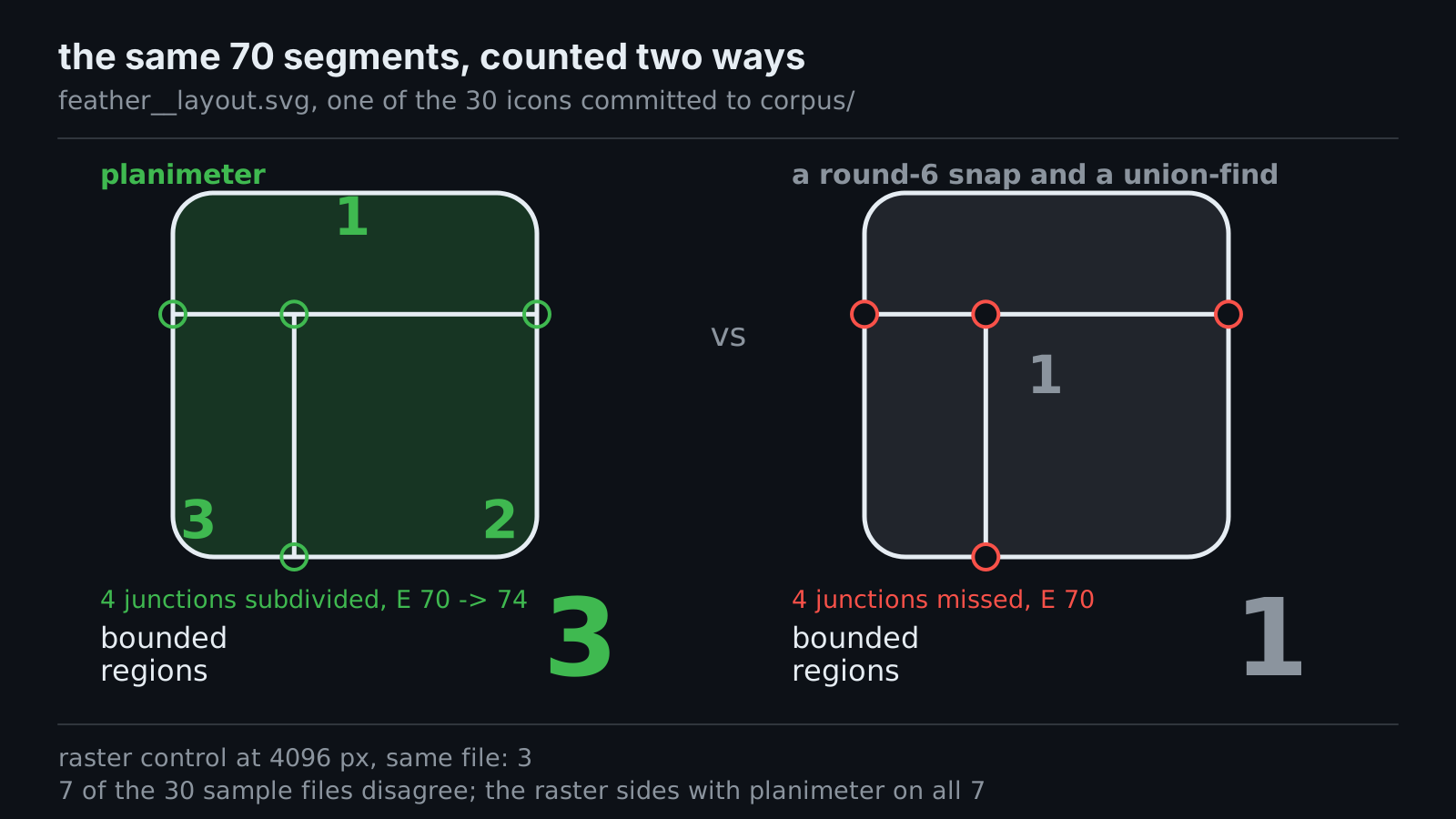
The round-6 strawman returns a different integer on 7 of 30, and on all seven
skimage.euler_number at 4096 px — a different library reading a different representation —
sides with the certified radius. The raster disagrees with the arrangement on 1 of 30, and that
one is the rendered-regions seam named above, not a counting error.
44 figure families × 6 levels of sigma/g in 1e-7..1e-2 × 2 seeds = 528 draws. Truth comes
from each family's construction recipe, and a test parses corpus.py's AST to prove the corpus
imports nothing from the package's counting, snapping or arrangement layers — so it cannot borrow
the arithmetic it is grading. These numbers say nothing about real files.
    planimeter                                    0 wrong   495 exact    33 refused  / 528
    round-to-6-decimals dict snap  STRAWMAN     350 wrong   178 exact     0 refused  / 528
    networkx b1 after a round-6 snap            350 wrong   178 exact     0 refused  / 528
    shapely polygonize_full(unary_union)        336 wrong   192 exact     0 refused  / 528
    shapely set_precision(1e-6) + the above     299 wrong   229 exact     0 refused  / 528
    skimage.euler_number @  512 px                2 wrong    64 exact     0 refused  / 66  (stride 8)
    skimage.euler_number @ 4096 px                7 wrong    59 exact     0 refused  / 66  (stride 8)
    CONTROL refuse-on-anything                    0 wrong     0 exact   528 refused  / 528
    CONTROL polygonize @ planimeter's radius     22 wrong   473 exact    33 refused  / 528
refuse-on-anything,0 wrong. A tool that refuses everything also scores zero. planimeter's zero is only readable beside its 495 exact, and both are printed everywhere the zero is.- The oracle control,
22 wrong.set_precisionhanded planimeter's own certified radius, thenunary_union, thenpolygonize_full. Had it scored zero, the counting layer would contribute nothing and the whole product would be the printed tolerance. It was the sharpest control in the design and it came back in the tool's favour. - The two raster rows are a pair, and the pair is the point.
euler_numberis exact and linear — there is no speed story here and none is told. What it needs is a resolution, and the answer moves with it: at 4096 px it is worse, 7 wrong against 2. STRAWMANis the benchmark's own word for that row, printed bybench.py, not a hedge added afterwards. See NOT EARNED.
Hook wall clock, 20 cold subprocesses per row on Windows, with a floor control added after the threshold was committed:
    FLOOR bare interpreter, no hook at all        52.4 ms median  [48.0, 70.8]
    silent path (.py write)                       56.4 ms median  [46.7, 62.9]  holds
    CONTROL same hook, suffix check removed      154.0 ms median  [138.9, 163.4]
    geometry path (.svg write)                   158.6 ms median  [145.0, 168.7]  holds
python -c pass costs 52.4 ms on this machine, so the silent path is a few ms of planimeter and
52.4 ms of Windows. That difference is two noisy medians subtracted — 9.0, 2.0, 2.4, 4.7, 14.6,
4.0 and 4.0 ms across seven runs — so the honest form is under about 15 ms, not a number.
The 60 ms gate sits 8 ms above the floor, inside the machine's own spread. Across eleven runs
three blew it and were printed as KILLS. The threshold has not been moved and every run is
reported, because a gate re-rolled until it passes is not a gate.
python -m venv .venv && . .venv/*/activate    # .venv\Scripts\activate on Windows
pip install -e ".[test]"
pytest -q                                     # 500 passed
python bench.py                               # sections 1-10, ~60 s
python realdata.py run --set sample           # section 11, on the 30 committed files
python realdata.py fetch && python realdata.py run   # 61 MB, not committed
python -m planimeter --demoNaming who did it first, and where they are better, is what makes the rest believable.
| work | what they have that this does not | what planimeter adds |
|---|---|---|
| gis-mcp (189★) | 92+ shapely / pyproj / geopandas tools placed directly in front of an agent over MCP — the strongest form of the objection, because no code interpreter is needed | its README has zero occurrences of polygonize, set_precision or euler: the tools are there, the certified-tolerance question is never asked |
shapely / GEOS ops.polygonize_full |
the face count, faster and more general, with a real diagnostic — polygons, cuts, dangles, and the unclosed edges by name | a return value that says which identification decided the count |
shapely.set_precision |
GEOS's own snap, and it will accept any grid size you hand it | the grid size, derived from the drawing and certified — or a refusal |
skimage.measure.euler_number |
exact, linear, a different library and a different algorithm — the third-party control this repo owes it | no raster, so no invented resolution; the raster answer moves between 512 px and 4096 px |
networkx |
E - V + C in one line, pure Python, already installed in most sandboxes — it reimplements the counting layer exactly |
the graph, which is the entire problem |
| CGAL / scikit-geometry | exact predicates, done properly, for decades | pip-installability (neither is on PyPI), and the intended question rather than the exact one — exact predicates make two nearly-coincident vertices genuinely distinct and return the exact face count of a graph nobody drew |
| Wolfram Local MCP | genuinely has the mathematics and local file access — the one real near-miss | free, and a hook slot; it returns an answer rather than a certificate |
pre-commit, lint-staged |
the whole "run a thing on every write" idea, for humans, years ago | the same slot for the agent, where every documented occupant today is a formatter or a linter |
| Gower & Ross (1969) | the theorem the window rests on: merge heights are the sorted MST weights | nothing — it is cited because that step is a theorem and not an empirical hope |
| Euler (1758) | the arithmetic | nothing |
Also standing on cleave and sigmoid — the same author's repositories the widest-representable-gap rule transplants from — and on tangle, whose shape this is: an exact integer, a one-directional certificate, a typed refusal naming what to re-observe, and a bench with controls.
- "Usable as a hook on a real floor plan" is withdrawn, not softened. The gate was committed before any number existed: exponent above
1.3, or above50 msat 100,000 vertices, and the sentence dies. Measured exponent1.83, extrapolating to740,531 ms. Both blown by orders of magnitude. - The comfortable range is under roughly 600 segments — 43 ms at 544, 1.9 s at 3,784 — and above the vertex ceiling it refuses
TOO_MANY_VERTICESrather than stalling a turn. The ceiling is a default, not a limit of the method:--max-verticesspends past it, at 40.0 s a file on a real 22,261-vertex plan. A k-d tree does not fix it — the certificate quantifies over every (vertex, edge) pair. - It is a linter for unnoded geometry, and that is now measured rather than feared. On 13,777 real files: 20.6% of icon files and 99.0% of Commons floor plans refuse, and once the vertex ceiling stops binding the refusals are almost entirely
EDGES_CROSSandVERTEX_NEAR_EDGE. On the advertised use case, floor plans, the answer rate is 1 of 96. - There is no refusal cliff. The design predicted a jitter level where everything certifies and a level two steps later where everything refuses. Refusals sit between 3 and 10 of 88 at every level, including the smallest, and do not order monotonically with the jitter. NOT EARNED. What is flat at zero across all six levels is the wrong count.
- Raising
rhodoes not make it stricter. Atrho = 100it gets 3 wrong: removing the genuine merge window leaves the merge-nothing window, whose ratio is drawing-scale over machine epsilon for arithmetic reasons alone. Zero-wrong is a claim aboutrho <= 10, andbench.pyprints that paragraph under its own table so the caveat cannot be separated from the number. - Two clean squares a tenth of their own size apart read as one piece. No jitter at all. 1.00 apart → one piece; 1.01 apart → two. Inside the stated convention, outside what a reader looking at the picture would say. It has a name in the corpus and a test.
- The design specified GEOS's Delaunay triangulation for the spanning tree. Measured, it omits a true MST edge on 1 of 793 point sets — all of them in the clustered stratum, which is exactly the stratum this tool exists for. Replaced with an exact vectorised Prim; shapely and GEOS left the dependency list with it, and "no GEOS-invented tolerance" became literally true rather than rhetorically true.
- A refusal the tool could not have made was being made. A budget refusal on the
2Ncurve-stability pass was reported asCURVE_UNSTABLE— go re-observe the drawing — when the machine had simply run out of room on a pass carrying twice the vertices. It hit 11 of 96 real plans, and one of them, at 1,295 vertices, was under the ceiling all along and certifies. - Reordering the ceiling check bought nothing at the default, and the arm is published as a loss. Guard-first measured 361 ms median across the 96 plans, spectrum-first 449 ms, and the repeat of guard-first 443 ms — the machine's drift is larger than the difference. It only pays at a raised ceiling, where one 22,261-endpoint plan goes from 41.1 s to 0.7 s. Verdicts identical on all 96 either way.
- Five claims were cut before the first line of code, three because a reviewer would have checked them: that
polygonizeoffers no diagnostic (false — it returns dangles and names the unclosed edges); that determinism and latency are differentiators (GEOS is deterministic, and shapely on a small file is already sub-millisecond); and a speed figure that was a persistent-homology number selling an Euler-characteristic tool. - The vision comparison was cut, not repaired. It scored perfectly only because it read exact coordinate text rather than a render. Re-running it against a raster is a different experiment than the one that was reported.
- NOT EARNED, and this is the load-bearing one. The accuracy headline's strongest comparison arm is a hand-written round-6 script, labelled
STRAWMANby the benchmark itself. The baseline that decides whether there is a product is the code an agent writes unprompted, sampled twenty times with the whole distribution published, and it has not been collected. If its median clears the stratum, the accuracy headline dies and what is left is the printed tolerance and the hook slot. That outcome gets published here, not hidden. - No agent-written file has been measured.
corpus/found/is still empty. The real corpus above was drawn by people in Inkscape and emitted by icon build tools, and none of it carries a ground truth, so it produces refusal histograms and method agreement, never an accuracy number. - The window rule is about ten lines of numpy — single-linkage clustering cut at the largest dendrogram gap over an MST — and nothing mathematical stops a sandbox agent from writing it. The guarantee is a policy,
refuse rather than guess, not a barrier. What an agent does not write unprompted is the vertex-to-edge quantifier and the exactly-incident subdivision, not the ten lines of clustering. Whether that holds in practice has not been measured.
Collected once, here.
- One machine, one OS, one Python. Windows 11, 3.11.9, numpy 2.4.6.
- The jitter stratum is synthetic. Its truth comes from construction recipes, so it measures the arrangement layer and says nothing about real files.
- The real corpus has no ground truth and no agent-written file in it. 13,681 npm icons and 96 Commons plans, drawn by people and by build tools. Every number from it is a refusal rate or an agreement rate between two methods. Refusal rates do not compose: 20.6% on icons, 99.0% on plans at one ceiling, and 3–10 of 88 per synthetic jitter level are three different questions.
- The
plansset is reproducible in method, not guaranteed identical in membership. The fetch is pinned by exact version for the icons and by fixed search terms for the plans, and Commons search results can move. corpus/real/sample/is 30 files, committed so the numbers can be re-run without a download. Its 100% answer rate is the icon set restricted to small files, not a headline.rho,CAND_MAXandFLOOR_ULPSare three constants this package chose, in a tool whose pitch is that it refuses to invent numbers. They are scale-free, printed on every answer, movable by flag, andrhogets a published sensitivity table. That is strictly more than shapely, GEOS or scikit-image offer, and it is still three chosen numbers.- Uniqueness of the certified scale is not established. At most 4 windows are tried, widest ratio first, first pass wins. A second window might also have passed.
facesis arrangement-theoretic and does not match what a renderer fills. There is no fix; there is the sentence and the refusal to claim otherwise.- Refinement stability across
Nand2Nis evidence, not a theorem. Two nearly tangent curves can gain or lose an intersection at any positive flattening tolerance. - SVG line work only, today.
planimeter.segments()is public, so feeding it geometry it cannot parse costs three lines. A JS/TS repo with no Python at all is a stated scope limit, not a gap to discover later. - Install the hook with
uv tool install planimeteror pipx, never a barepipinto a project venv — a venv-relative hook silently never fires the moment the venv is not active. - The hook slot is someone else's schema. If the
PostToolUsepayload shape changes the stamp silently stops, and every hook error is deliberately silent. A recorded-payload fixture test andplanimeter init --checkare the mitigation.
- Sample the real baseline (G1). Twenty unprompted first-attempt agent scripts against the closed-form corpus, whole distribution published, classified by which library each reached for. This is the gate that decides whether the accuracy headline lives.
- The found corpus (G5, G6). The refusal histogram now exists for 13,777 real files with no truth. What is still missing is the specified corpus: ~30 real agent-written SVGs with truth established by a second method before planimeter runs on them.
- A sweep line for the incidence pass. The
1.83exponent is the all-pairs (vertex, edge) quantifier, and §11 says what fixing it would buy: the median Commons plan carries 6,398 endpoints against a 2,000 default, and--max-verticesreaches them at 40 s a file. The all-pairs pass stays as the sweep line's test control. - More readers — GeoJSON, WKT, DXF — shipped when the found corpus contains that format, and not before.
- MCP.
gis-mcpowns that surface with 92+ tools; the hook is the difference. Ask if you want one.
import planimeter

c = planimeter.chi("walls.svg")             # Chi, or Refused. Never raises for geometry.
c.pieces, c.faces, c.chi                    # 1, 5, -4
c.t_below, c.t_above, c.ratio, c.radius     # the certificate
c.grid_source                               # "derived" | "user"
c.json()                                    # the machine shape

planimeter.chi("plan.svg", max_vertices=6000)   # spend past the default vertex ceiling
planimeter.chi_segments(seg)                # from an (m, 2, 2) float64 array — no parser
planimeter.segments("walls.svg")            # the escape hatch: array + ids + skipped
planimeter.check("walls.svg", faces=5)      # HELD | BROKEN | REFUSED
planimeter.snap.window(points)              # the honest seam, exposed on its own
bool(Refused(...)) is False and int(Refused(...)) raises TypeError naming the reason, so
if faces(f): cannot silently read a refusal as truthy. Every module carries a runnable
self-check: python -m planimeter.snap, python -m planimeter.arrange, and so on.
MIT · python ≥ 3.9 · RESULTS.md · Invented by Teerth Sharma · teerths57@gmail.com · github.com/teerthsharma/planimeter
euler-characteristic · planar-arrangement · betti-number · union-find · certified-snap ·
typed-refusal · agent-tooling · posttooluse-hook